Translation of what I'm saying: "Hello my friends! I came to Mongolia from the states because I love Mongolia and Mongolian language. Come study with us!"
In honor of my new roommate, who is herself an animal, here's a list of animals in Hulunbuir Evenki. Loans noted:
Important livestock (all borrowed from Classical Mongolian):
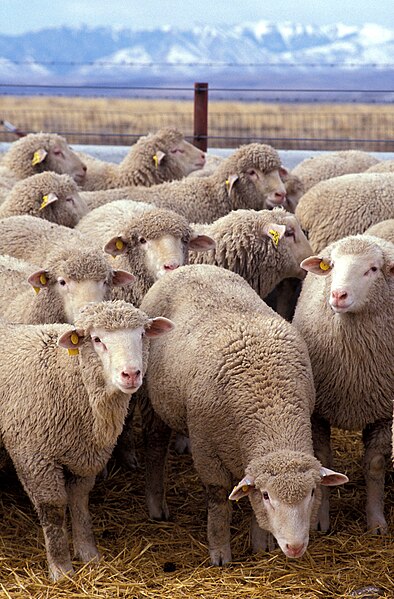
qɔnin: sheep
ukər: cattle
mɔrin: horse
jamaɣan: goat
If you're familiar with the Mongolian concept of tav maɬ "five herds", perhaps you've noticed that these are four of the five important animals kept by the Mongols, so it makes perfect sense that Mongolized Evenki would borrow these words. However, there are only four here! What about the other one? The other animal, the camel, is not in Evenki because they live too far north. However, if there was a word it would be something liketəməɣʌn, which is the modern Chahar pronunciation of Classical Mongolian temeyen.
Other Mammals:
inakin: dog (compare Mong. nɔxɔɪ)
bɔqa: deer (compare Mong. bʊqa)
kɔskə: cat (from Russian koʃka)
guskɔ: wolf
Other Vertebrates:
dʊ'gi: bird
tamədʊ'gi: eagle (it would be interesting to see the meaning of "tamə")
kɔɮin: snake
ɔɮdɔ: fish
Let's count to ten in Hulunbuir Steepe Evenki! I'd like to add that my being able to do this amused my informants to no end. They would bring their friends over to hear the funny foreigner count in their native language.
Descriptive Grammar of Evenki:
https://archive.org/details/rosettaproject_evn_morsyn-4
QUICK CORRECTION: I did not mean to insinuate that digin "four" was a recent borrowing. This is a pure Tungusic word (e.g. Manchu "duin") but may reflect borrowing on an ancient level, or if Altaicists are correct, they may even be true cognates.
Also, sorry for the jumpy video, but we don't need fluid movement as long as the board is visible and the audio works!
Hulunbuir Steppe Evenki greetings and introductions:
ajə biʃindi -- Are you well?
ajə -- Well, good
ʊrʊ -- Bad
ima gɔrbitʃ biʃin di? -- What's your name?
nameɪ xaɣar -- My name is Khagar (mountain)
ʊrʊntʃutʃʊ -- Thank you
ʊ:tʃla:ʃræ -- Sorry (from Mongolian)
bajartæ -- Goodbye (from Mongolian)
1) How did you find the Evenk (sic) in the countryside? Did you just wander around and ask (in Chinese) everybody you saw if they were Evenki? How upset were the Chinese guards? 2) I remember reading somewhere that the Ket were driven northward not by the Evenks, but that they moved themselves northward to avoid being stuck inbetween the Russians and Tatars. Both groups demanded tributes/taxes from the Kets, but the Kets could afford to pay only one. Thus, they moved north so they would be completely in Russian territory. They also didn't have to worry about Tatar attacks there.
Let’s talk about Mongolian food. Usually when we Americans think of Mongolian
food, we think of “Mongolian Barbecue”, recently popularized by several chains
back in the States. How this name came
about I’m not sure, as it’s neither Mongolian nor barbecue. For the uninitiated, M.B. is basically
Chinese stir fry served in a Mongolian theme restaurant. It’s the Asian equivalent of “Outback
Steakhouse”...a delicious fraud:
As another analogy, imagine going into your local Mexican
joint and being served Kung Pao Chicken.
That’s Mongolian Barbecue. The
problem is not, mind you, the food itself.
I love a good stir fry. The
problem is the dishonesty, or at least the benign ignorance, of calling it something it’s
not.
And it doesn't end there.
One popular M.B. chain makes the claim, which is now a widespread
belief, that M.B. originated with Genghis Khan’s soldiers using their shields
as woks. Preposterous. This story was dreamed up in an
air-conditioned office in Cleveland by some white people in ties. A nomadic warrior carrying around a sack of
rapidly-spoiling veggies, rice and other stir-fry implements would be slowed
down considerably, and before long end up dead.
Why would you do that when you have a perfectly good food source that
can walk, feed and reproduce by itself?
And not only do sheep/horses/goats/camels/cattle (the “big
5” of Mongol pastoralism) provide you with food, they provide you with clothes,
shelter, milk, transport and load-bearing. They can even get you drunk, if you ferment or distill the milk. When’s the last time you saw a bell pepper do any of this? Vegetables suck. They’re good for nothing but sitting around
and going bad:
Even Nancy Reagan says NO to veggies!
Not only that, but vegetables are incredibly
labor-intensive. You have to stay in one
place and farm them. Mongols don’t farm,
they pillage people who farm. Do you
know what the Mongolian word for fruit/veggies is? Tsagaan Khoolh “white food”. In this case the “white” has some connotation
of effeminacy or weakness.* That’s right;
the Mongolian word for veggies is “wimp chow”.
Vegetarians have it hard here.
Real Mongolian cooking doesn’t even use woks. A soldier in the Mongol Hordes would be more
likely to use a wok as a shield than vice versa. Woks feature nowhere in the Mongolian
kitchen. But you know what do? Hollowed-out marmot carcasses:
Awesome.
Real Mongolian cooking is the manliest culinary tradition in
the world. Mongolian food, by and large,
requires only two things: fire and dead animals. You don’t even need utensils. You eat the meat with your hands and a
knife. I can’t think of a single
Mongolian dish that isn’t entirely or almost entirely animal products. You know what the Mongolian equivalent of a
Thanksgiving turkey is? Roasted sheep
head. They have it on special occasions
and give it to the guest of honor.
Again, awesome.
Even Mongolian tea is badass and manly. In the States we don’t really think of tea as
being badass, more the province of hippies, Englishmen and other enemies of
freedom. Red-blooded Americans drink
coffee. Black, maybe with a little
milk. But even here Mongolians have us
beat. Mongolian milk tea is the manliest
morning beverage in the universe. Let me
explain:
First, you start with a brick of tea. How, you may ask, does tea come in
bricks? Mongols have done this for
centuries. Traditionally, the leaves are
pressed and held together with COW BLOOD.* Holy crap. Is there anything
about Mongolian food that doesn’t kick ass? (Hint: no.)
So, you break off a chunk of blood-tea and boil it. Meanwhile, you take an equal measure of
milk--whole, none of this lo-fat nonsense-- some butter, salt to taste, and
maybe a bit of cooked rice, if you’ve plundered any farms recently. Mix together, and enjoy. The resulting high-calorie tour de force is
less tea and more broth. It’s great for
floating dumplings in or dipping meat.
In the latter case, by the end of your meal you have bits of meat and
blood sausage floating in the tea, which improves the taste. Then you drink it, sharpen your sword, and overthrow the Song Dynasty:
* Although the term does have its origins in the literal white color of dairy products--basically it initially referred to anything that wasn't the actual flesh of an animal.
*http://templemountaintea.com/wiki/temple-mountain-tea-wiki/tea/forms-of-tea-for-consumption/tea-bricks/