Monday, June 13, 2016

What's the Deal with Taiwan?


Given that last month I went on a trip to Taiwan, I thought it would be cool to discuss today what exactly Taiwan is. Is it a country? A part of China? Or something else entirely?

To understand the situation with Taiwan, we have to go back in time to 1949. The Chinese civil war is raging, between the nationalist Republic of China and the communist People's Republic of China. The communists are gaining ground every day as they advance southward. The nationalists have but one final hope: to retreat from the mainland to the island of Taiwan, there to regroup and someday stage a comeback. The relocation is successful, and the ROC establishes Taipei as its provisional capital. To this day, Taiwan, along with a few islands off the Mainland's coast, continues to call itself the "free area of the Republic of China", and has developed politcally and economically apart from the Mainland. Although initially a pseudo-fascist regime under the despotic Chiang Kai-Shek, the ROC has developed into a modern multiparty democracy with a first-world standard of living. The ROC claims to be the legitimate government of all China. Some countries, such as Swaziland and the Vatican, accept this claim, and maintain ROC embassies rather than those of the PRC.

Meanwhile, back on the Mainland, the People's Republic of China declared victory in October 1949, and continues to refer to Taiwan as a province, using scare quotes in news media when referring to the ROC and its government organs. As each republic claims the territory of the other, the two sides to have to toe a careful line to avoid a war of catastrophic proportions, especially as the US has vowed (in theory) to support Taiwan in such a conflict. As J. Maarten Troost said in his excellent book Lost on Planet China, there are probably no more than a dozen people in the US who could muster up any enthusiasm for an apocalyptic war with China over Taiwan, but all twelve of them probably have jobs at the White House.

Basically the status quo, sometimes called the "1992 Consensus", is that China is one country with one legitimate government. That government, depending on your opinion, is either the ROC or the PRC.

All of this would be a much simpler matter if there were only two sides to the debate, but there's a third: the Taiwanese independence movement. Basically, before becoming the last redoubt of the ROC, Taiwan had been inhabited for hundreds of years by speakers of southern Chinese varieties, and for thousands of years before that by Austronesian speakers—the Austronesian language family being widely spoken arcross the South Seas. As you might expect, both the southern Chinese and Austronesian-speaking populations were none too happy about Mandarin-speaking mainlanders suddenly showing up and setting up camp on their island. This led to the claim that Taiwan is in fact a nation unto itself. Their slogan is "Taiwan is Taiwan, China is China". They want Taiwan to shed its Chinese trappings and become the independent "Republic of Taiwan". Such a move would alienate the descendants of the 1949 refugees who have—rightly—come to see Taiwan as their home. Also, it would trigger an invasion from the PRC, which would be less than fun.

Fortunately for everyone, I have a plan. I have an awesome idea for solving the ROC-vs.-Taiwan dispute that, even if it doesn't make everybody happy, at least it pisses everyone off equally. I told my idea to a girl working at the hostel in Taipei, and she said it was "a good idea...just really stupid".

My proposal hinges on an important, but often-overlooked fact: the free area of the ROC doesn't only comprise Taiwan. The ROC also controls Matsu and Kinmen, two archipelagoes along the mainland's coast:
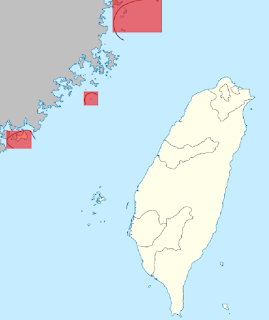


Apparently, from Kinmen it's even possible to see the mainland on a clear day. Matsu and Kinmen form a separate province within the free area of the ROC, Taiwan being the other. So, while administered by the ROC, the archipelagoes are not part of "Taiwan", geographically or even politically.

This in mind, here's my proposal: first, the ROC grants Taiwan Province—i.e. all of the free area of the ROC except for the three archipelagoes—regional autonomy. Perhaps something could be worked out similar to the relationship between Denmark, Greenland and the Faroe Islands. Greenland and the Faroes are essentially independent countries that are diplomatically represented by the Danish crown. In return, Denmark is responsible for Greenlandic and Faroese national defense. A similar situation could be worked out between the ROC and Taiwan. While the ROC manages foreign relations and national defence, Taiwan could be a de-facto independent country-within-a-country. Having given Taiwan self-rule, the ROC could relocate its seat to Kinmen and Matsu. While these islands are quite small, it's not as if they're uninhabited rocks. They have cities. People live there.

Of course, this relocation is only a temporary measure until Chinese reunification. At that time, the government relocates to the mainland, and Taiwan is granted formal and complete independence.

As far as I can tell, this proposal seems fair to all parties involved:

1. The ROC continues to exist, and maintains its presence in Taiwan, at least formally, until it reunifies with the mainland.

2. The Taiwan independence movemeent gets autonomy now, and independence later. The promise of independence is a motivation to support the ROC in Chinese reunification. As an added bonus, the ROC relocates its government off of Taiwan proper.

3. The PRC can continue, technically speaking, to make the claim that "Taiwan is part of China". As long as they can do this, they have promised not to bomb Taiwan back to the stone age.


So, what do you think? Good plan, or should I keep my day job? If you're Tsai Ing-wen (the ROC president) and you want me in your cabinet, let me know by leaving a comment!

Sunday, June 12, 2016

Geography of China


Let's talk about what, in a geographic sense, I mean by the word "China". I've had a lot of friends tell me that they're familiar with a few places in China—e.g. Shanghai, Beijing, and Tibet—but aren't super familiar with the country beyond that.

In today's parlance "China" usually refers to the territory controlled by the People's Republic of China—although it could also refer to the Republic of China (i.e. Taiwan) or even the ancient civilization to which both political entities are heir. I'll be talking about the first today, and to a lesser extent the second.

Chinese people like to imagine their country as looking like a giant chicken chilling with two eggs: 


 Let's start from the chicken's head.

The head of the chicken is known these days as the Northeast (Chinese: Dongbei) although historically—and erroneously—it was referred to as "Manchuria" in Western scholarship. This is kind of the Alaska of China. Cold winters, lots of snow, lots of bears, things like that. Since the 19th century this area has become increasingly Sinicized, but originally the inhabitants of this region were not speakers of Chinese at all. Instead they spoke Tungusic and Mongolic languages, two language families that have more in common with Siberia than China. The most historically widespread of these languages is called Manchu, but these days only survives only as a dialect in the far west of China. In the actual Manchu homeland, barely any speakers are still alive. It was the Manchu who conquered China in the 17th century, establishing a dynasty that would survive into the 20th.

The chicken's back more or less corresponds to what is today known as Inner Mongolia.  I've been here a few times, and even hitchhiked across it. At one point in a really remote area I was actually arrested, since they thought I was an American spy—but I was innocent! Fortunately the police realized after a few hours of questioning that I really was just a harmless linguist, so they let me go. We even ended up making friends. So, notwithstanding my brief run-in with Johnny Law, Inner Mongolia is a cool place. It's also where some very conservative Mongolian dialects have been preserved. Also still in use is the beautiful vertical mongolian alphabet, which in the Republic of Mongolia has been replaced with Cyrillic. Sadly, however, Inner Mongolia is in the ending stages of Sinicization, and in the cities and towns Chinese is spoken more than anything else.

To the south, stretching from Beijing to Vietnam, and Shanghai to Sichuan, is what I like to call "Core China". It was historically referred to as "China Proper", but we don't really use that term anymore.  What we mean by this is that historically this region has been inhabited primarily by Chinese speakers. Chinese-speaking civilization developed in the north, in the Yellow River basin, but gradually spread south, displacing and assimilating other peoples as it went.

The Yellow and Yangtze rivers are of paramount importance, of course, and there's a huge poplulationl living along them. The major population centers along the Yellow river are Xi'an city—that's where the Terracotta Warriors are—and the densely populated Henan, Hebei, Shanxi, and Shandong provinces; in translation, River-South, River-North, Mountain-West and Mountain-East. Further south, along the Yangtze, we have the cities of Chongqing, Wuhan, and of course Shanghai. Some important provinces are Hubei, Hunan, and Jiangxi (matter-of-factly named lake-north, lake-south, and river-west).

Further south, just along the Tropic of Cancer, we have the very populous Guangdong (expanse-east) province with the major cities of Guangzhou and Shenzhen. It's also here that we have Hong Kong and the lesser-known Macau, which are in essence semi-autonomous city-states. While technically under Beijing's control, they have their own governments, currencies and flags.

And it's here in the south that we get to the chicken's two eggs: the islands of Hainan and Taiwan.

Hainan is basically the Chinese answer to Hawaii. It's this beautiful tropical island paradise where people like to go on vacation. Personally, I'm not super interested in going because I think I'd die of heat exhaustion, but I have been to Taiwan, which is a little further north. Of course, Taiwan's political status is disputed, and as a foreigner it's not really my place to have an opinion. Regardless of the island's political status, however, it is very much Chinese in terms of language and culture. Historically, Taiwan has been home to speakers of Austronesian languages—that is, the same language family as Malay, Maori and Hawaiian. These days, however, everybody speaks some variety of Chinese, and even Austronesian speakers usually use Chinese at work and school. Taiwan's a cool place, I was there last month, I really recommend it.

Let's turn now toward the chicken's wing, that is, southwest China. We have two important provinces here, Yunnan and Sichuan.  I'll also mention Guizhou, since I need to represent my hood. But really, Guizhou is kind of the North Dakota of China. Whenever I tell a Chinese person that I live in Guizhou, they always give me a weird look and ask me what the hell I'm doing there. It's actually a nice place to live, if not the most cosmopolitan. But just like the rest of China, it's developing every day. Believe it or not, we even have not one, but two Starbucks!

This area of China is interesting because we have a lot of indigenous ethnic groups here who speak languges that are more closely related to those of Southeast Asia. For example, in Guizhou there's quite a large Hmong population, which is more often associated with Laos and Vietnam than China. We also have in this region some very beautiful, spectacular mountains which really are the foothills of the Himalays. That leads us, of course, to Tibet.

Regardless of how you personally feel about Tibet, right now it is, for better of worse, firmly under the control of the People's Republic of China. However, despite what some Chinese nationalists would have you believe, this has not always been the case. In fact, it wasn't until the Mongol Empire that Tibet and China were in incorporated into the same political entity—and even then, of course, both Tibet and China were subject to the Mongolian Khans.

North of Tibet we have Xinjiang, which is also not really a Chinese-majority area but has historically been under Chinese influence, and occasional control.  Here we have Turkic-speaking groups like Kazakhs and Uighurs, although just like Inner Mongolia, and the Northeast before that, it's becoming more Sinicized as Chinese-speakers move in. It's not really my place to comment on the Sinicization of minority areas, but I will say that I think people have the right to live wherever they like, as long as they respect the local culture and language. Is that happening in Tibet and Xinjiang? Some say yes, some say no. I've never been there myself, so I can't really say. I know that it's not happening in Inner Mongolia. The region is linguistically flooded by Chinese, to the point where most people don't even learn Mongolian. Chinese is the language of the cities, and you have to go deep into the countryside to find Mongolian in practical use. I think that's a travesty, and it shows that many of the Chinese speakers living there don't really respect the linguistic heritage of the region.

So that's a very basic overview of China's geography, and as we continue talking about Chinese language and culture you'll be hearing a lot more about these places. Up next: What's the Deal with Taiwan?